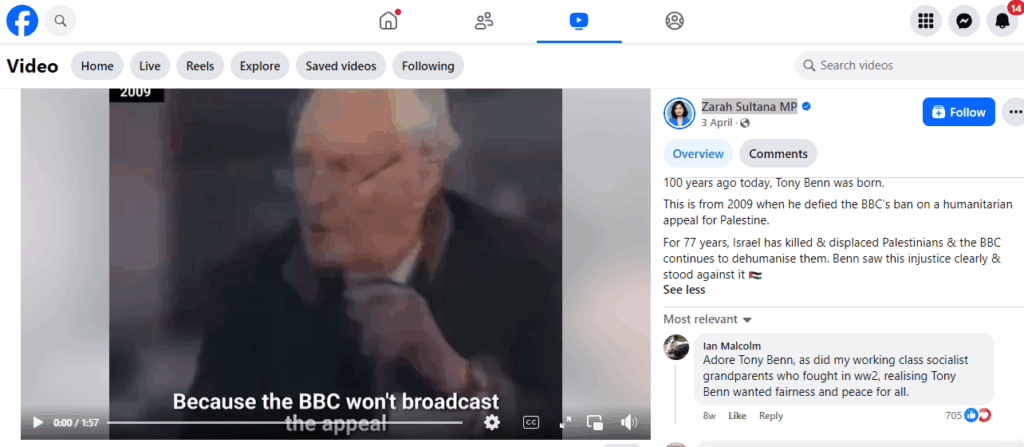
Tony Benn: “Let’s be clear, the reason the BBC hasn’t done it is because the Israelis objected.” View on Facebook
The BBC’s censorship of voices speaking out against Israel’s war on Gaza—and in support of Palestinian liberation—is nothing new. Back in 2009, the late British politician Tony Benn publicly condemned the BBC for refusing to air a humanitarian appeal for Gaza following one of Israel’s deadly assaults.
In a live interview with the BBC, Benn was explicitly told not to mention the appeal. He refused. On air, he called out the broadcaster’s decision, stating bluntly: “Let’s be clear, the reason the BBC hasn’t done it is because the Israelis objected.”
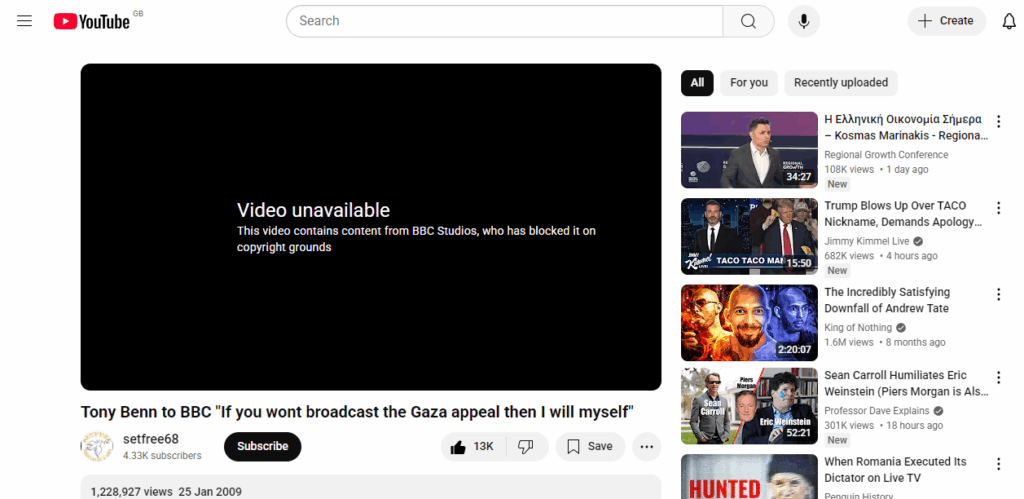
That clip, once available on YouTube, has since been removed. In its place is a notice: “This video contains content from BBC Studios, who has blocked it on copyright grounds.”
The clip of Benn censored by YouTube after a take down request from the BBC
So while the BBC continues to amplify Israeli and Zionist narratives, it is also reaching back in time to erase dissent—even the principled stand of one of Britain’s most respected parliamentarians.
But it’s mistaken if it thinks it can silence the world. The task is too vast, and information now too fluid, for such control to succeed. Copies of the clip are circulating on Facebook , X (formerly Twitter), and elsewhere. Many have already seen it. It will not disappear.
The BBC should have learned from Herostratus: some names—and some acts of defiance—cannot be erased.
As the saying goes, if it looks like a duck, walks like a duck and quacks like a duck… it’s a duck.
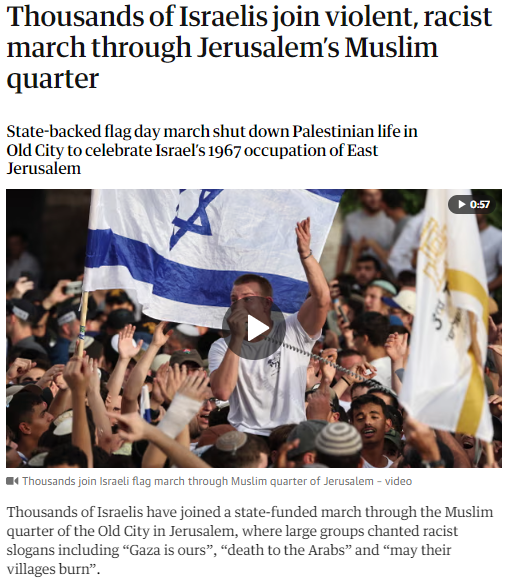
If one were to ask, “What would a Nazi state look like in 2025?”, this Guardian article offers a chilling contemporary example — even if the word “Nazi” is never used. The features it documents — racial supremacism, state-enabled pogrom-like marches, theocratic nationalism, educational indoctrination, historical myth-making, and de facto apartheid — are all hallmarks of a fascist ethno-state.
Here’s a deeper analysis by ChatGPT as to why the Guardian article, perhaps unwittingly, presents Israel as undeniably a Nazi state:
1. State-Sanctioned Ethnic Supremacy and Ritualised Public Intimidation
The article describes:
A state-funded, municipally promoted march celebrating the military conquest of an occupied city.
Participants chanting “death to Arabs”, “may their villages burn”, and “Mohammed is dead”.
The use of slogans like “without a Nakba there is no victory” — openly glorifying ethnic cleansing.
In a Nazi state, one expects state-enabled rituals that assert dominance over an ethnic or religious underclass. That’s what this march is. The Guardian notes that Palestinian shops were shuttered under police pressure (“Shut now, or I can’t protect you”), and residents were barricaded in their homes — an unmistakable climate of organised terror.
2. The Collapse of Civic Equality and the Fusion of Religion and Nationalism
The article reports that:
Women and men march separately “for religious reasons”.
Marchers wear school-branded T-shirts and symbols of a banned terrorist movement (Kach).
The event is presided over by senior cabinet officials like National Security Minister Itamar Ben-Gvir, a known Jewish supremacist.
This reflects a theocratic ethno-nationalist regime, in which religion is not a private or communal matter but a state-aligned ideology, used to dominate public space and erase pluralism.
3. Historical Revisionism as a Tool of Ethnic Domination
As attorney Danny Seidemann observes, biblical mythology is “being weaponised” by state-backed settlers to justify the erasure of Palestinians. This mirrors how Nazi ideology used Teutonic myths and Volkisch history to legitimate expansionism and genocide.
Netanyahu’s decision to hold a cabinet meeting in Silwan — a Palestinian neighbourhood claimed as “biblical Jerusalem” — is an act of symbolic domination comparable to a Nazi rally in annexed Prague or Warsaw.
4. The Role of Education and Youth Indoctrination
The participation of Israeli high schools in organising student involvement shows how educational institutions are mobilised to inculcate ideology and recruit foot soldiers — a key feature of Nazi Germany’s youth policy.
5. Police Complicity and the Normalisation of Racial Violence
The article repeatedly highlights the impunity with which Jewish marchers harass, steal from, and threaten Palestinians, while Israeli police do little to intervene. This is institutionalised racial supremacy — where law enforcement exists not to protect all citizens, but to reinforce the ruling ethnic group’s power.
So we see that whether one uses the term “Nazi” or “Zionist” here, is partly rhetorical. But by function, the answer is unmistakable. Israel is a Nazi state.
You bewail injustice and unprovoked evil, Proclaim your innocence, your purity of heart, Brand the helpless as murderous Nazis, Regretfully kill children in self-defence, Then demand the world stand by your side.
Israelis have not come to resemble the people who murdered European Jews 80 years ago. They began that way. Zionist Jews arrived in Palestine as Europeans — not only by passport, but by mindset. They belonged to the same world that produced centuries of Christian persecution, pogroms, ghettos, and finally the death camps. What changed was not the logic of domination, but its direction. Once victims, they became settlers. And now they kill Palestinians.
This is not a Jewish genocide. It is a European one — a continuation of colonial violence by other means, carried out by descendants of Europe’s victims with Europe’s blessing. The West supports this not out of ignorance, but because it suits them. The alliance rests on three things: guilt, interest, and fear.
First, guilt — the need to atone for the Holocaust without confronting the systems that made it possible. Supporting Israel is cheaper than reckoning with fascism’s roots in Western civilisation. Second, shared interest — Israel is a ready-made outpost of Western power in a region that resists it. Third, and perhaps most significant today: fear. Fear of being smeared, shamed, or ruined. To criticise Israel is to risk being called antisemitic — a word that now functions less as a moral warning than as a political weapon.
Yet this fear is irrational. Europeans and Americans have more to gain from an honest friendship with the Arab world than from clinging to a relationship with a rogue ethnostate. Even in cold strategic terms, Israel is becoming a liability. But political, military, and financial entanglements are easier to sever than psychological ones. The real hold Israel has over the West is emotional — built on guilt, intimidation, and a long-standing inability to confront its own fascist past.
Zionism was born in Europe, not just geographically but ideologically. It emerged from the same currents that produced nationalism, racial hierarchy, and colonial conquest. It is not foreign to the West — it is the West. One of its 20th-century offspring, exported and rebranded, but still recognisably of its flesh.
The liberation of Palestine may depend, ultimately, on the liberation of Europe — not from some external force, but from the Zionism it birthed, exported, and now fears. Until that rupture occurs, the genocide will go on, and the West will keep funding it — not because it must, but because it cannot yet bear to stop.
The JAZ Connect platform aims to map, document, and amplify anti-Zionist Jewish voices — individuals, organisations, movements, and traditions — in a publicly accessible and strategically useful form. But is it really a new contribution? Does anything like it already exist?
The answer is no — not in this form, not with this scope, and not with this purpose.
What Exists Now
There are, of course, many anti-Zionist Jewish organisations and initiatives. Some of the most visible include:
Jewish Voice for Peace (JVP) – the largest anti-Zionist Jewish organisation in the U.S.
IfNotNow – a movement of young American Jews opposing the occupation
Jews for Justice for Palestinians (UK) – longstanding and outspoken
Independent Jewish Voices (Canada) – a national platform for anti-Zionist perspectives
Neturei Karta – ultra-Orthodox and vocally anti-Zionist for religious reasons
Beyond these are local synagogues, student groups, academic figures, and cultural workers who speak out, organise, and resist.
But these efforts are:
Organisational rather than structural
National rather than global
Often siloed or isolated
Fragmented across ideological, generational, and religious lines
There is no unified infrastructure to record, connect, or make searchable the vast, diverse, and growing body of Jewish anti-Zionism.
What’s Missing
There is no platform — as of yet — that offers:
A living, global directory of anti-Zionist Jewish individuals and organisations
Searchable metadata by geography, ideology, role, and focus
An archival and public memory function that documents this movement across time
A resource built not just for internal Jewish re-evaluation, but to support the broader Palestinian liberation movement
A space for anti-Zionist Jews to find one another, reflect, and de-Zionise collectively
JAZ Connect proposes to do exactly that.
Why It Hasn’t Been Done
There may be reasons — implicit and explicit — why such a directory doesn’t yet exist:
Fear of recentring Jews within the Palestinian struggle
Concern over backlash, doxxing, and social/professional risk
Absence of funding or institutional support
A desire to avoid appearing self-congratulatory or factional
These concerns are valid — but they are not sufficient to justify absence.
On the contrary, the lack of such a tool has allowed Zionism to continue claiming a monopoly on Jewish identity — and allowed anti-Zionist Jews to remain isolated, invisible, or denied as aberrations.
Why It Matters Now
JAZ Connect doesn’t propose to create a movement. That already exists. It proposes to record it. To connect it. To make it undeniable.
A tool like JAZ Connect would:
Strengthen solidarity
Counter Zionist propaganda
Support Jews seeking to de-Zionise themselves and their communities
Offer Palestinians and others a reliable map of principled allies
The need for it is not theoretical. It is strategic. And long overdue.
JAZ Connect is not a new idea. It is a long-neglected one. Now is the time to make it real.
It’s a fair question. After all, we’re told constantly that Zionism represents “the Jewish people” — as though dissent is marginal, rare, or irrelevant. The reality is very different.
🧭 The Estimate
We conservatively estimate that:
Over 500,000 Jews worldwide either reject Zionism outright or align with abolitionist/post-Zionist perspectives.
Hundreds of Jewish organisations — from grassroots collectives to religious groups, media outlets to international alliances — exist with a clear anti-Zionist stance or practice.
These numbers are difficult to pin down precisely, but here’s what we do know:
In the United States:
A 2021 Jewish Electorate Institute poll found that 25% of U.S. Jews under 40 believe Israel is an apartheid state.
Among the same group, only 34% said caring about Israel was “very important” to their Jewish identity.
Major organisations like Jewish Voice for Peace (JVP), IfNotNow, and dozens of regional Jewish groups take explicitly anti-Zionist or abolitionist positions.
🌍 Internationally:
The UK, Canada, France, Germany, Australia, Argentina, and South Africa all host visible and growing Jewish anti-Zionist communities.
Groups like Jews for Justice for Palestinians (UK), Independent Jewish Voices (Canada), and Neturei Karta maintain longstanding public opposition to Zionism — sometimes for religious, sometimes political reasons.
Hundreds more operate below media visibility — in congregations, student movements, cultural spaces, and activist collectives.
Why Don’t We Hear About Them?
Because Zionism dominates institutional Jewish representation: from federations to media, from synagogues to lobbying arms. Anti-Zionist Jews are routinely ignored, excluded, or attacked — dismissed as “fringe,” “self-hating,” or “not really Jewish.”
That’s exactly the purpose ofJAZD: To document, amplify, and connect the vast and principled world of Jewish anti-Zionism that already exists — and cannot be erased.
But they are indispensable. Their role in confronting Zionism and the apartheid, genocidal state it has built is not just important — it may well be essential to Palestinian liberation.
Why a Directory of Jewish Anti-Zionist Voices?
The goal of a global directory is simple: to increase visibility, amplify voice, and coordinate effort. JAZ Connect exists in support of the Palestinian struggle — and to document the Jewish refusal to let Zionism speak in their name.
Zionism must be confronted where its defences are weakest: from within the very community it claims to represent. It must be exposed not only as a colonial assault on Palestinians and Arabs, but as a betrayal of Jews — whom it claims to protect.
When Jewish voices are attacked by Zionists for speaking out, the lie collapses. The lie that Zionism is Judaism. The lie that Israel speaks for all Jews. The lie that opposing Zionism is antisemitic.
In truth, to oppose Zionism is to affirm Jewish existence — ethically, historically, and spiritually.
What JAZ ConnectOffers
The lie is already collapsing. But the collapse needs structure. It needs memory. It needs a map.
The JAZ Connect platform is designed to be a living, searchable record of Jewish individuals and organisations across the globe who have said no to Zionism. Publicly. Unambiguously. Often at great personal cost.
This vast reservoir of principled, courageous Jewish dissent needs a focal point. JAZ Connect steps up to that task. To our knowledge, no such platform currently exists.
JAZ Connectexists to:
Amplify anti-Zionist Jewish voices
Act as a resource for journalists, organisers, and activists
Help Palestinians and others locate principled allies
Refute the idea of a universal Jewish-Zionist consensus
Support Jews seeking to de-Zionise their identity, history, and traditions
It is a resource, a witness, and a tool of solidarity.
Call for Contributors
If you are:
A Jewish anti-Zionist willing to be listed
An organiser or researcher who can help expand and verify entries
A designer, coder, writer, or outreach worker who believes in this project
We want to hear from you.
You can help shape categories, contribute leads, refine orientation labels, or support outreach and platform development. Your involvement — no matter how small — helps shape a tool of global consequence.
Reply to this post or get in touch. Let’s build something that cannot be ignored. And cannot be silenced.
Two influential Jewish Americans promote two of the most pernicious anti-Semitic tropes.
In a castigating plea, Harvard professor Ruth Wisse urged Jews everywhere not only to unflinchingly support Israel but to “stand and salute” Benjamin Netanyahu as their leader, warning: “Don’t you dare minimise our leader, don’t you dare call him a chicken shit.”
Wisse will be understood by many to be saying that diaspora Jews should regard Netanyahu as their rightful leader — a statement echoing one of the most malignant anti-Semitic tropes: that Jews are more loyal to their own group, and to Israel, than to the nations they live in. Others have had their careers ruined for far less. But Wisse’s commitment to Zionism overrides any concern for how her words might appear — or what consequences they may have.
Ruth Wisse insists Benjamin Netanyahu not “chicken shit”. Credit: Glenn Greenwald.
While it is true that some Jews are more loyal to Israel than to America — and Wisse herself seems to exemplify this — she appears to argue that this is not a betrayal but a duty: that the natural obligation of American Jews is not to America first, but to Israel. That Jews worldwide should regard themselves not as full and equal citizens of their own countries, but as followers of a single nationalist project centred elsewhere.
Wisse is not alone. Former U.S. Republican Senator Norm Coleman recently lamented that Israel was “losing the digital war,” as public opinion in the U.S. turns sharply against it. His response was not to question Israel’s policies but to call on Jews everywhere to counter this shift — because, in his words, “Jews are the masters of the universe.”
Norm Coleman declares Jews “masters of the universe”. Credit: Glenn Greenwald.
He backed the claim by citing Jewish leadership of major digital platforms: Sam Altman of OpenAI, Mark Zuckerberg of Meta, Larry Page and Sergey Brin of Google, and Jan Koum, who founded WhatsApp. In doing so, he not only echoed another classic anti-Semitic trope — that Jews control global institutions — but reinforced it, urging Jews to leverage this alleged control in Israel’s defence.
The grotesque irony of Coleman’s words is inescapable. For centuries, Jews were persecuted, expelled, and slaughtered by people who believed they were masters of the universe. Now, a Jewish political figure reclaims that language — not in warning or lament, but in encouragement.
Both Wisse and Coleman claim to speak for Jews. But what they really speak for is Zionism. And that distinction is everything.
Judaism and Zionism are not synonymous. In truth, they are antithetical. Judaism is a religion of conscience, of right conduct, of standing before God. Zionism is a political project built on land, conquest, and the domination of narrative. Judaism teaches: “What is hateful to you, do not do to your neighbour.” Zionism answers: “Dominate your neighbour before he dominates you.”
Yes, Jews are disproportionately represented in media, technology, academia, and government. But this is not evidence of collective conspiracy. And when Jews in these positions act in service of Zionist aims, they do not act as Jews — they act as Zionists. That distinction must be defended, not blurred. It is the difference between faith and chauvinism, between exile and empire.
Israeli Prime Minister Benjamin Netanyahu has just accused UK Prime Minister Keir Starmer, French President Emmanuel Macron and Canadian Prime Minister Mark Carney of “siding with Hamas” following the shooting of two Israeli embassy staffers in Washington, DC. This, despite all three leaders, along with many others, publicly condemning the attack.
The context is telling. Just days earlier, Starmer’s Foreign Secretary, David Lammy, delivered a blistering rebuke of Israel’s actions in Gaza. Though he stopped short of formally labelling it genocide or announcing sanctions, Lammy’s language was unambiguous: “Palestinian children are being bombed, burned, and starved to death,” he told the House of Commons, adding that “millions have been displaced in what many view as ethnic cleansing.” He condemned not only Israel’s starvation policy and aid blockade, but also what he called the “vile, genocidal language” of Israeli politicians and media commentators. (gov.uk source)
There was strong cross-party support for this position, including calls for recognition of the State of Palestine and growing use of the word genocide by sitting MPs. Earlier that week, Starmer, Macron and Carney had issued a joint statement demanding an immediate ceasefire and the full restoration of humanitarian aid to Gaza — warning that if Israel failed to comply, “concrete actions” would follow.
Netanyahu now claims that such statements not only embolden Hamas, but have also incited antisemitism and contributed to the Washington shooting. This is extraordinary: a sitting Israeli prime minister accusing his strongest international allies — who continue to supply arms, intelligence, and diplomatic cover — of siding with “mass murderers, rapists and baby killers”. It would seem an act of political self-sabotage, unless one of two things is true: either Netanyahu has some form of leverage over these leaders, or the entire spectacle is theatre — a bruising battle of words designed to create the illusion of real confrontation while allowing Israel to complete its work unimpeded.
And so, amid this performance of condemnation, the ethnic cleansing proceeds — not just of Gaza, but quite possibly of the West Bank. The West can later say it tried, that it voiced concern, that it raised alarms. Israel, for its part, will continue to deny any crimes were committed. And the world, ultimately, will move on. Voters will be herded back to domestic issues. The threat of electoral reckoning will vanish. And Israel will have solved its “Palestinian existence” problem.
Far-fetched? Maybe. But history suggests otherwise. The fact that Israel has been able to violate international law, comprehensively and with impunity, for 58 years since 1967 — and arguably since 1948 — strongly implies it can continue to do so. And with increasing confidence.
Because ultimately, as nearly all serious analysts agree, the scaffold holding up this artificial island of faux democracy is the United States — with its unblinking veto power, military lifeline, and deluded conviction that it somehow profits from all this. For Israel, condemnation from anyone but Washington is just water off a very slippery duck’s back.
Until the U.S. wakes up and realises that its costly loyalty to a single rogue state brings far less benefit than friendship with dozens of Arab nations — nations it does not need to prop up with weapons, and whose collective wealth dwarfs America’s — then nothing will change. Until Americans realise they are materially poorer because of their blind support for Israel, the apartheid will continue, and so will the bloodshed.
Donald Trump, of all people, may have an opening here. Should he choose to break the Zionist spell and sever the cord, he might actually earn that Nobel Peace Prize he keeps fantasising about. He could be remembered as the president who finally set America free — and opened the door to a new era of non-interventionist diplomacy, unchained from the toxic legacy of Israel-first foreign policy.
Israel would then face a choice. Either join the international community of mostly law-abiding states — including, notably, the State of Palestine — or become a pariah, starved of capital and attention, as global diplomacy and finance pivot away toward 400 million Arabs who, as economist Jeffrey Sachs puts it, the West will no longer need to sanction, bomb, or occupy on Israel’s behalf. (Sachs article and video below.)
Jeffrey Sachs spells out Israel’s policy of getting the US to go to war on its behalf.