The knives are out for Boris Johnson as events unfold at a pace even hungry reporters are finding dizzying to keep up with.
Till now it has proven difficult to pin down the Convict, as John Crace of the Guardian calls Johnson. Or, rather more aptly, to grab hold of the Greased Piglet, who after 3 years has made a right pig’s ear out of government and the office of Prime Minister.
But thanks to Chris “grab them by the bollocks” Pincher, the trail of corruption, incompetence and lies has finally led to where it was always going to lead: the slaughterhouse. Though Johnson for the time being hangs on like a turd that refuses to flush, soon we will hear him squeal his last, particularly since today he vowed he would still be Prime Minister in the morning, a defiant last stand of idiocy guaranteed to galvanize those calling for his departure into making sure he does.
The only note of caution of course is who comes next. Looking at the line-up – led by Sajid Javid, who thinks Ayan Rand’s soporific ode to capitalism Atlas Shrugged is the best book ever written, and Rishi Sunak, who built a swimming pool in his Yorkshire mansion whilst half the country survive on food banks – the country might not be any worse off if they kept Johnson.
At least Johnson is only self-obsessed, attracted like a moth to power, in need of adoration, and bloated with a sense of being a chummy leader who lets his minions have a good time boozing while they work. He is not ideologically driven and doesn’t care about policy, and would never be dangerous in the way Jacob Rees Mogg or Priti Patel would be.
Whoever it is, the country will still be in a mess until politics itself changes. That, as will be set out later, will only happen when AI is in control. Not of the people, but of the politicians and their corporate masters.
This could pass as the average profile of a right wing conservative in America. The overturning of Roe v Wade in June 2022 is what some are calling the thin edge of the wedge. Soon, they fear, all other freedoms and rights will be under threat, all sanctioned by the highest authority in the land.
I pose a way out of this scenario, tentatively proposing that it meets with the principles of humanism:
Whoever defends the greatest freedom to be and the greatest freedom of expression, in accordance with the principles of moral reciprocity and equal consideration of interest, has the right to over-rule and if necessary subdue those who seek to limit and deny such expressions only in accordance with their personal, unsupported beliefs.
This could possibly be justified as follows:
The overruling of authoritarians, who by definition base their authority on unsupported claims and beliefs, should not be unacceptable to them, because overruling others without appeal is precisely what authoritarians advocate. Being overruled cannot therefore be seen as immoral or unjust on the part of authoritarians, and is on the contrary a natural consequence and indeed a practical application of their insistence of the denial of the rights of others without rational basis or appeal.
Perhaps with a little work this could fly and would meet with the principles of humanist reason and ethic.
Sir Kier Starmer delivered an impassioned plea to the British public to support the RMT in it’s bid for better pay and work conditions.
“I urge the British public to stand by our Rail workers,” Sir Kier said when visiting the RMT headquarters today. “It is in our interests as people who use public transport as much as it is in those who work to ensure it runs safely and reliably.
“Today we can work from home. Explain to your boss that to safeguard your future ability to travel into work you feel you must take action now.”
Sir Kier went on to mention ways in which ordinary people could support striking workers whilst minimizing personal disruption.
“If you are planning a pleasure trip, why not postpone it? If your trip is essential for health or grave personal reasons, take your car, or ask a friend or neighbor for a kindness. If you are in a position to offer transport then register on our app, where you will be put in touch with people in your area who need a lift to somewhere important. “
If you try these and other options and they prove impossible get in touch with your local Labour representative’s office. We’ll make sure your important journey takes place.”
Sir Kier then made a surprise statement on the politics, or on what he claimed was not the politics, of the strike action.
“I was asked what would a Labour government do if faced with a strike of similar circumstance. Or any strike in which the action is clearly justified. Are we not exploiting a situation that would, just as for the Tories, place us in a difficult position? Would not a Labour government feel its authority was being challenged regardless of the justice of the action? I answered that if a Labour government responded in the same way when the justice of the action was clear, I hope the public would respond as I am urging you to respond now. Support the strike.
“This is not about politics. Though politicians may reduce it to that. It is about people’s lives. Democracy means we can challenge our governments, and I would not be a democrat if I failed in my duty to support workers . Therefore I should be challenged if ever i failed to do what i am urging us all to do now. To support the strike.
“Let us stand together. The well being of those who serve us is the well being of us all.”
I imagine that many of us often raise our hands in despair when thinking of how to change the social and economic system under which an entire planet is yoked. A profit driven system, with those profits going to just a few as the planet is trashed and the majority struggle along, often going without.
It may be simpler than we think to stand up to Capitalism. Purchasing a train ticket recently I was outraged at the cost. Disproving Mrs Thatcher’s disingenuous argument that privatisation stimulates competition, drives down prices and raises standards as companies vie to attract customers, 35 years on the route is monopolised by the Great Western Railway, on which I was obliged to buy an unpleasant “sardine class” journey at an exorbitant price.
On this occasion I decided to do something and not simply accept my station in life. As I paid for the ticket I politely told the teller clerk that the cost is outrageous, the service inferior, and the experience unpleasant and that he should pass the message on to management. That I would also vote for political parties that promise to re-nationalise the rail system, and ask other passengers to do the same. (At which point I flashed my “Crusade for Public Transport” badge).
Perhaps he never passed it on. Though perhaps if enough people were to take that active stance, rather than passively standing there whilst shareholders rob us in broad day light, then maybe prices will come down. Though the long term aim is of course not just to bring prices down, but capitalism itself.
Tragically, we speak not a pop band but another senseless massacre by gun and, as nearly always, in the USA, this time in Texas.
Disingenuously, gun lobbyists declare it has nothing to do with guns. Gun control advocates; that it has everything to do with it.
The latter position might seem to be the most obvious and logical (see responses to bad faith arguments below). Yet gun supporters are unrepentant in their continued refusal to accept that guns, though they may not cause massacres or gun violence and killing in general, nonetheless facilitate these atrocities, as well as scale them up many more times than would be the case should other weapons be implicated.
Apparently there is no clear data on the matter either way, if that is to be believed. And we are left to argue for or against gun control depending on how we view the matter personally.
There is no need for this fruitless subjective wrangling, however. There is a simple way to find out once and for all which position is correct and beneficial to society and the individual. Guns have been widely and easily available for decades and in fact centuries in the USA. Therefore, it makes sense that a period without guns, or at least with severe gun control prohibiting use away from licensed shooting ranges, would almost certainly uncover the reality.
If gun advocates cannot produce scientific data that refutes without a shadow of a doubt the intuitive link between guns and the frequency and severity of mass killings then they are obliged to agree to the experiment of living without guns for a period of time, say 2 decades. That should be enough to show whether there are fewer events and/or fewer causalities and deaths.
It is a reasonable proposal, and rejecting it would reveal an unwillingness to address the problem in every way possible. If there is doubt as to whether or not guns engender more frequent and/or exacerbate gun violence and killing, this doubt is enough to justify living without them for a while to see if those doubts are born out.
Everything should be tried, and questions should be asked of those unwilling to do so.
Some bad faith arguments offered by gun lobbyists in defence of lax gun control:
It’s not guns but people who are the problem. Response: Sure, but guns add to it hugely.
Anyone with a knife can wreak havoc and kill many people. Response: It can happen if the conditions are right, but rarely, in comparison to gun massacres. Usually knife attacks are limited in casualties and deaths, for obvious reasons. Such as: you can’t stab someone across a room; or way down a corridor as they run away. It is a physical fact that it is far, far easier to kill many people with a gun than with a knife or axe.
Owning guns allows people to intervene when someone runs amok. Response: You wouldn’t need to intervene if guns were removed from general circulation and confined to ranges and resorts. Or at least tightly controlled. And besides, it is difficult to recall when an altruistic gun owner intervened and saved the day.
Dear Mr Xi Jinping, I read about the re-education camps in your country. They look fabulous. I’ve been thinking of attending summer school for a while, and this sounds ideal. How can I apply? Your faithfully
Watching the experts on Free Energy demonstrate their secrets of perpetual motion raises a small question.
Why not make money from the free energy method they’ve discovered rather than making videos about it?
A comment by jetplaneflyer on the video below perhaps answers this:
“When I was at school we made a very similar electric motor in class. Only difference being that we didn’t hide the battery that powered it under the table!“
When cat videos no longer help pass a moment pleasantly, perpetual motion is a good second best.
Yet another earns a great comment similarly inspired by the Second Law of Thermodynamics, left by jayanth yk:
“My house runs completely on free energy. I steal my neighbor’s electricity lol“.
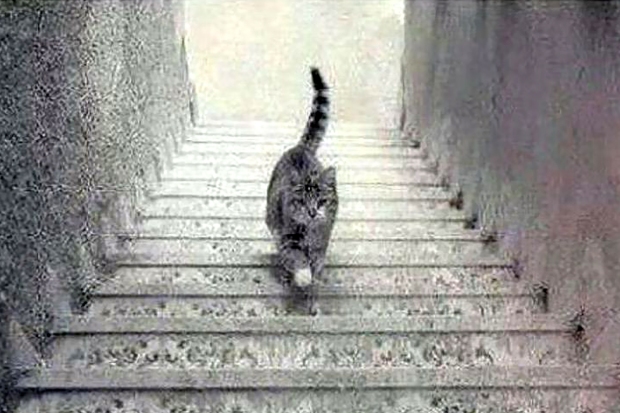
The image appearing in The Sun newspaper, shared by the Mind Journal
The apparent illusion invites you to decide whether the cat is going up or down the stairs.
The Sun columnist Jacob Bentley-York writes of the image (“shared” with him by the Mind Journal):
“Whichever way you see the cat walking exposes your approach to life, it claims. Both viewpoints are said to have definitive meanings.”
Happily for Bentley-York, he does attribute the claim to the the Mind Journal and not to himself.
Then follows a summary of the analysis according to the Mind Journal, of the two ways people might see the image.
Going Up
If the cat looks as if it’s going up the stairs, you’re likely an optimist, according to the Mind Journal. There are soaring claims of positivity in such a view, such as rising higher in life, seeing potential and growth wherever one looks, and “clear signs of ambition in you and no one, except yourself, can stop you from going higher in life.”
Going Down
If on the other hand you are addled with a mind that sees the cat going down the stairs, the picture is not so rosy.
“You are a skeptic, to be honest,” the Mind Journal states, (apparently implying this is a bad thing).
“It may have been based on your experiences in life or just because of the sort of people you may have met that tilted your view of life towards the negative side. But this means that you don’t trust easily now, you calculate before you commit and you are wary of people who seem too sweet. It may just be your way of tackling the world but you are much sharper and shrewd in your dealings, making it almost impossible to trick or deceive you.”
So overall, if you saw the cat going down the stairs you are a negative, suspicious and untrusting person, with the possible advantage that it is very hard to sell you something you don’t need.
Clearly, the Mind Journal analysis chimes with the widespread idea that being an optimist is a good thing, and that being a pessimist is a handicap and not much fun. It ignores completely the third possibility, which is to be a realist, be it a miserable or cheerful one, examining all interpretations that result from vague first impressions, allowing reason to determine precisely what is going on.
So What’s Going On?
The problem with the sort of folk psychology displayed in this particular instance is not its definition of optimist and pessimist, but the fact that it does not apply to the so-called illusion of the cat on the stairs.
As the entry in the Mind Journal itself points out (after you are shown the image and asked to decide), the cat is clearly walking down the stairs.
“You may notice a slight shadow under the overhanging nose of the stair treads. These shadows would only be visible if the cat was going down the stairs towards the viewer who is looking upstairs.”
And that indeed is the case. Stone or marble stairs (as the image appears to show) are constructed using a top horizontal slab resting on a vertical slab, to form the box shape of each step. Sometimes there is no overhang of the top slab, and so no protuberance or ridge as seen in the photo. But whether there is or not, for obvious reasons of stability the top slab will always be laid so as to rest on the vertical slab, and not such that it will sink behind it.
Frequently, the top, horizontal slab does indeed overhang the vertical. This is possibly for aesthetic reasons, though likely there is a construction or durability advantage to the overhang itself.
In the image with the cat the top edge of each step protrudes markedly, seen especially clearly in the step at the very bottom of the image. But it is not only the shadow formed by the ridge that highlights the fact that the stairs is being viewed from the bottom (and thus the cat is descending), because light could just as well be coming from below as above, resulting in no shadow. It is the fact that our brains have learned that stone stairways always have the top slab resting on the lower vertical slab, and so no ridge forms as viewed from the top. And as noted, frequently the top slab does indeed overhang the lower vertical slab, as viewed from the bottom of the stairway.
One may see very rare exceptions to this, where the top slab does not rest on the vertical slab, and so will in time sink under its own weight and the impact of footfall. A ridge would then form protruding upwards. This presents a serious hazard of catching your heels on the ridge and falling headlong as you descend, so thankfully we almost never come across stair ways like this.
There is a second feature of the image that further demonstrates the cat is descending the stairs. If the cat were going up, then not only will the stair case have been constructed by a fool, there would also be dirt and debris packed up against the ridge. None, however, is visible (unless it was cleaned just before taking the photo).
This so-called optical illusion, then, shows us absolutely nothing about being an optimist or pessimist. If anything, all it shows is that people who view it as a cat ascending are failing to see the world as it is. Which arguably could severely disadvantage them and perhaps be fatal in some circumstances. One could be harsh, and rather than labelling them cheery optimists with a bright future ahead, they are happy-go-lucky panglossians, easily duped and ready to settle for the first impression or explanation that comes along. Beware!
Correctly viewing the image as a cat descending, on the other hand, deserves a pat on the head, and perhaps a tin of tuna, because your brain correctly interpreted the world. The worst that can be said about you is that you are indeed a realist.
If there is anything else to say in all this nonsense about uncovering optimist or pessimist tendencies in our interpretations, it is that it’s another form of creating illusory differences and divisions that do not help us get along. The Sun page hosts a survey, with roughly 68.2% claiming they viewed the cat as ascending, 29.3% descending, and 2.5% unsure. The problem with the survey is that it comes after the analysis of the two views of ascent or descent are explained, thus biasing the reader towards the cheerier outlook. How many people adjusted their answer when voting so that they would avoid admitting, to themselves and not simply to The Sun, they are pessimists when in fact they are realists?
Though I think that even “realist” may be a problematic label in itself. Punto, labels are problematic.
To cast some serious light on this, in conclusion it is helpful to call on a higher authority. If asked to decide on the matter, Erwin Schrödinger would surely have answered that until you looked at it, the cat was “going both up and down the stairs.”
Speaking on the BBC Radio 4 Today program (7 March 2022), Brian Chesky talked of a difficult decision that in the end had to be made. Asked whether this would set a precedence, for example with regard to a potential attack by China on Taiwan or indeed with regard to the ongoing brutalisation of the Uighur people, Mr Chesky declined to give a firm response, though he did outline what currently guides Airbnb ethical policy.
“With regard to Airbnb communities all over the world we have a non-discrimination policy and work hard to remove listings of any community member violating our policy of antidiscrimination, consistently looking country by country making sure we can defend our practices.”
Given the crime committed by Mr Putin in invading Ukraine and the atrocities the Russian president is causing Russian soldiers to commit, there seems to be a sound argument for Airbnb to boycott Russian property owners in line with their ethics policy. At the same time it is a shame that whilst Airbnb seem to have a semblance of an ethical approach, for which they are to be applauded (admittedly encouraged perhaps by the general Russia sanctions movement and “guidance” received from the US government, as Mr Chesky put it), Airbnb lacks consistency with regard to any lasting and far reaching ethical stance, the very which Mr Chesky was vague about when responding to the BBC reporter.
This is not the first time properties and owners have been banned from Airbnb on the basis of violations of human rights and international law. In 2018, in response to lobbying by the Boycott, Divestment and Sanctions (BDS) movement in aid of Palestinian human rights, Airbnb agreed to remove Israeli owned properties in the occupied Palestinian lands and the Syrian Golan Heights, both territories considered under international law as illegally militarily occupied and illegally settled.
This folding in the face of threats of a false anti-Semitic smear was remarkable, since Airbnb need not fear. If ever there was a clear case for an ethical stance supported by concrete evidence it is the boycott of Israel until it respects international law. There is no controversy or doubt whatsoever that Israel and Israeli settlers are in violation of human rights and International Law on land occupied through conquest. It is there to read in the United Nations Resolutions on Palestine, and many Israelis and Jews themselves are appalled by such conduct and consistently call it out.
Yet the anti-Semitic smearing of Airbnb and the righteous motive underlying the boycott was enough to force capitulation by Airbnb. (Ben and Jerrys’ have, on the other hand, held steadfast to their boycott on selling their brand of ice cream not just in the occupied Palestinian lands, but in Israel itself).
This will remain a mark on the moral integrity of Airbnb and its shareholders, and listening to Mr Chesky speak of his resolve to boycott Russian and Belarusian owners, the whiff of the climb down over Jewish property owners illegally occupying Palestinian lands was, like the proverbial elephant in the room, palpably all around him. It must surely have been in his consciousness as he spoke.
It is a shame on many levels, because as we listen to the gasps of shock and horror surrounding the vicious attack on Ukraine, and that this should not be happening in the 21st Century, Airbnb is missing an opportunity to be among those to lead the way forward through century, making ethics solidly part of their brand and sticking to it come what may. It is particularly onerous on businesses to be ethical in the 21st Century, since aside from what they think of themselves as ethical beings, despite their power and reach they can no longer present a moral face to customers whilst dealing with those who commit crimes and violate international law. (The Russian people are not the ones committing the crimes, but unfortunately there is no other way but sanctions to isolate Russia right now.)
The American Petroleum Institute provides an important public information service. Though this is mainlyon behalf of the fossil fuel sector, and not actually for the advancement of truth and public understanding.
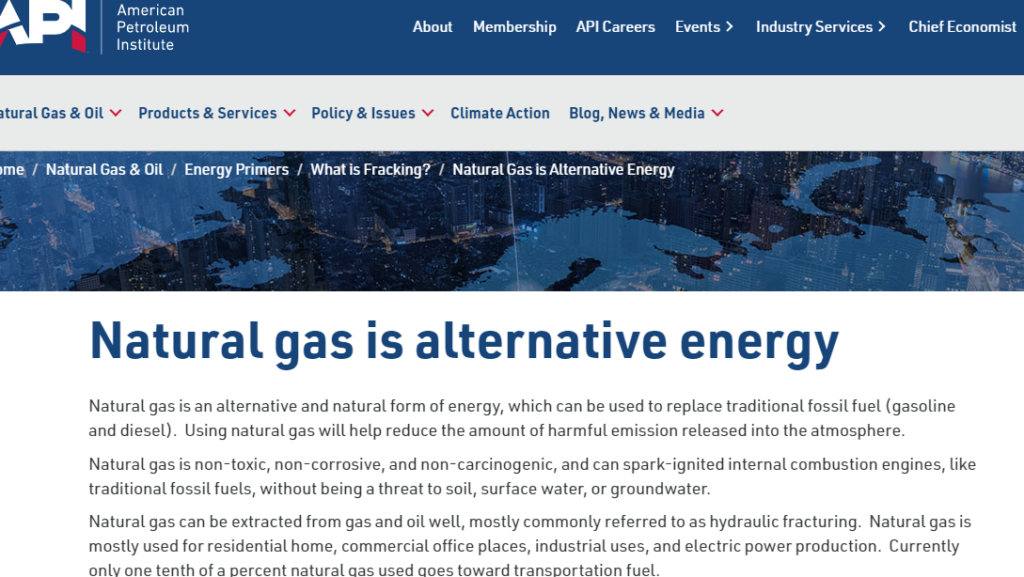
On a page entitled “Natural gas is alternative energy”, the API boldly states that “Natural gas is an alternative and natural form of energy, which can be used to replace traditional fossil fuel (gasoline and diesel).”
Screen shot of the API misinformation page on Natural Gas, as on 02 March 2022. PDF available here.
There are two things to note about this page. First, the grammar and writing are appalling, and second, it is wholly misleading, simply in that first sentence, without considering the rest of the poorly written text.
Whilst natural gas does produce fewer harmful emissions than do oil or coal, under the universally accepted meaning of the term, natural gas is not considered “alternative energy”. Using the phrase “alternative energy” to describe natural gas is misleading, further compounded by referring to oil and coal as “traditional fossil fuels”, giving the impression that natural gas is not in fact a fossil fuel but without directly saying so. To see this verbal slight of hand more clearly, a look at what is meant by the terms “fossil fuel” (or fossil energy) and “alternative energy” is useful.
“Fossil energy” is used to describe combustible materials produced naturally from the decomposition of organic matter – remnants of plants, animals, plankton and bacteria – fossilised over millions of years under great heat and pressures deep within the Earth. (See also the Smithsonian definition of fossil fuel.)
“Alternative energy” on the other hand, refers to forms of energy that are not the result of fossilised decomposition of organic matter over millions of years. This includes renewable alternative energy such as wind, solar, biomass, hydro, tidal and wave, which are all replenished continuously by the sun; and non-renewable alternative energy such as nuclear and geothermal. It takes in both combustibles (wood, bio gas), and non combustibles (wind, tidal etc.) The essential attribute and defining criterion of this category of energy source, however, is that its formation is not viafossilisation of dead animals and plants over millions of years.
“Alternative energy” and “fossil energy” are thus used to designate two separate categories of energy source. The term “alternative energy” is now universally used, understood and accepted throughout society (academia, media, government, industry and down at the pub) to refer to all sources of energy that are not derived from fossil fuels.
That’s my definition of alternative energy. Here are some others:
Usable power (such as heat or electricity) that comes from a renewable or green resource. (Merriam-Webster)
Energy fuelled in ways that do not use up the earth’s natural resources or otherwise harm the environment, especially by avoiding the use of fossil fuels or nuclear power. (Oxford Lexico)
Energy sources considered to be alternatives to fossil fuel sources (Engineering Wiki)
Interestingly, Wikipedia does not have a separate entry for alternative energy and redirects to the page on renewable energy. This is probably testament to the fact that “alternative energy” is not only understood to mean energy sources that are not fossil fuel derived, but that the term has by now become more or less synonymous with renewables that produce little if any harmful emissions, and which constitute the majority of alternative forms of energy.
The other point to note is that this accepted differentiation between alternative energy and fossil fuel energy does not at first consider the impact either form of fuel has on the environment. The fundamental defining criterion that distinguishes alternative energy and fossil fuel energy is the manner in which they are formed. Their categorisation is not ultimately in regard to what they are used for or the effects they have, and not even in their chemical composition or how they are extracted or otherwise obtained. It is how they are formed that is the fundamental bases by which “alternative energy” and “fossil fuel energy” are distinguished and taken to constitute two different categories of energy source. The fact that alternative forms of energy are less harmful to the environment than fossil fuels is significant of course, and in fact is why it is useful to invent a distinguishing term. But it is not the fundamental criterion by which we clearly distinguish these sources of fuel.
Natural gas is indisputably obtained from deep within the Earth, and moreover always in association with oil and coal, or perhaps intermediate forms such as peat. Critically, the formation of natural gas is uncontroversial in scientific terms, and can only be explained as resulting from the decomposition of the remnants of ancient organisms buried deep within the earth and subject to enormous forces and heat.
Clearly then, natural gas does not fit into the universally accepted definition of alternative energy. It is not alternative, because it is in fact a fossil fuel. Stating that “natural gas is alternative energy” is a gross misrepresentation, exploiting the received meaning of alternative energy (as just set out) to circumvent public unease at the continued use even of this less harmful fossil fuel (natural gas), when cleaner forms of energy are available.
How This Slight of Hand is Pulled Off
We have established that with the term “alternative energy” the American Petroleum Institute is using misleading language to describe natural gas. The API in fact conflates variety with category. Natural gas is a variety of fossil fuel, not an alternative to it, because in the context of energy, “alternative” refers to a different category and not a different variety of energy source. Stating that natural gas is “alternative energy” is similar to saying a wooden dining chair is alternative seating to a textile armchair. Whilst trivially this is true, categorically it is false. They are each a variety of seating, alternatives if you like and wish to be pedantic, yet they are still both part of the same category of furniture – “things to sit on” – commonly known as seating or chairs. Similarly with dogs: there are varieties among them – called breeds – yet they all still belong to the same category or species of animal “dog”.
And so it is with with oil, coal and natural gas: whilst trivially they can be viewed as alternative to each other, they are still all fossil fuels, only different varieties. They are all part of the same category of hydrocarbon based energy sources produced via ancient fossilisation and decomposition of the remnants of plants and animals over millions of years. Each is simply a different form – or breed if you like – of fossil fuel, just as a Chiwawahua and Great Dane are different breeds of dog.
And like chairs made from different materials and in different shapes and sizes, oil, coal and gas each have a use for which they are best adapted, natural gas being the lowest emitter of harmful substances when used for power generation. Coal and oil contain impurities absent in natural gas, many of which produce substances that are highly toxic when burned, such as dioxides of nitrogen and sulphur. Coal and oil are therefore best left unburned and are best used in processes that extract useful compounds for applications such as plastics and fertilisers. Natural gas therefore emerges as a better, alternative form offossil fuel for energy production.
In the specific context of fossil versus non fossil energy such as wind, solar and hydro, the API identification of natural gas as an alternative energy is, as just noted, grossly misleading. It is not an alternative energy source, just a different form of fossil fuel. It is the the API’s use of language universally understood to mean “forms of energy that are non-fossil derived” that constitutes the slight of hand, by all appearances deliberately conflating variation within a specific category with variation between categories. (The variations are oil, coal and gas; the category is energy sources). An apple is an alternative form of fruit to oranges, to adopt the strange language of the API, but they are still both part of the category fruit. They certainly differ with regard to appearance, taste and how they are constituted, but they both share all the characteristics and are subject to the same criteria that we use to define fruit as a distinct category of food.
Where the API should have used different form or variant, they have used alternative, thus hijacking the accepted use of this word in the context of energy and harmful greenhouse gas emissions. The conflation is, on the face of it clever. The API does not actually claim that natural gas is not a fossil fuel; it simply uses language to misrepresent and mislead us into thinking that it is not a fossil fuel. This is further assisted by referring to oil and coal as “traditional fossil fuels”, which has the effect of further falsely differentiating natural gas from oil and coal, again without actually claiming that natural gas is not a fossil fuel similar to oil and coal.
To round things up, at the end of the article the API inaccurately states that:
“Most natural gas is fossil fuel formed by heat and pressure on organic material and form (sic) over millions of years. Natural gas can come from landfill gas and water/sewage treatment…“
This is also patently misleading. As noted here, natural gas is the name given to all (not most) of the gas that is formed under heat and pressure over millions of years. The gas that is produced from landfill, water and sewage treatment, and also in bio-reactors is a renewable resource termed biogas, to distinguish it from non-renewable natural gas. Both categories of gas may have a similar hydrocarbon structure, yet the process of their formation is entirely distinct in each case.
The API misinformation is a difficult slight of hand to unpick, easily missed by those not yet alert to attempts by the fossil fuel industry to thwart regulation of fossil fuel burning, further delaying the widespread use of alternative and renewable sources.
It is also another eye opening example of a shameless “alternative truth”. To drive the point home to the apprentice alternative-truther who wrote this appalling and grammatically challenged piece: natural gas is not alternative energy. It is just an alternative form of the precious, unique, irreplaceable yet highly polluting fossil fuels that we currently burn as if there were no tomorrow.