This post appeared on X.
The following was sourced using Gemini LLM:
The 1900 pamphlet Or la-Yesharim (meaning “Light for the Upright” or “Light for the Righteous”) is a foundational text in modern Jewish history. Published in Warsaw by Rabbis Shlomo Zalman Landa and Yosef Rabinowitz, it was the first major, unified rabbinic manifesto explicitly written to condemn Theodor Herzl’s political Zionism. [1, 2, 3, 4, 5, 6]
Its historical significance stems from how it fundamentally altered the religious and political landscape of Eastern European Jewry:
1. The First “United Front” of Traditional Orthodoxy
Before the late 19th century, Eastern European Orthodox Jews were deeply divided. The Hasidim (mystical, dynastic sects) and the Mitnagdim (their rationalist, non-Hasidic opponents) had spent over a century in bitter theological conflict. Or la-Yesharim is historically significant because it served as a catalyst for a truce. Faced with what they saw as the profound threat of secular nationalism, both factions put aside their differences to sign and endorse the collection. This unity laid the institutional groundwork for what would eventually become the modern Haredi (Ultra-Orthodox) movement and parties like Agudat Yisrael. [1, 2]
2. Formulating the Core Theological Critique of Zionism
The anthology gathered letters and rulings from the era’s most prestigious rabbinic authorities—including Rabbi Shalom Baer Schneersohn (the leader of Chabad Lubavitch) and the renowned halachic authority Rabbi Hayim Soloveitchik. Through these letters, the pamphlet permanently codified the main arguments of religious anti-Zionism: [1, 2, 3]
- The Messianic Overstep: They argued that Zionism was an illegitimate attempt to rush the divine redemption of the Jewish people. According to their view, the Jewish exile was decreed by God, and return could only be achieved miraculously through the Messiah, not via secular human politics. [1]
- Nationalism as a Substitute for Torah: Rabbi Schneersohn argued that Zionism was fundamentally different from previous historical rebellions against Jewish tradition. While older movements broke specific laws, Zionism attempted to redefine Jewish identity itself—replacing a covenant based on Torah observance with a modern, secular secular-nationalist identity. [1]
3. Shattering the Dialogue and Creating the “Mizrahi” Split
The publication of Or la-Yesharim effectively ended any chance of a unified response to the challenges of the 20th century. [1]
- The Fracture: Up until 1900, many traditional religious Jews were willing to closely monitor or even support early Zionist settlement efforts (Hovevei Zion). The fierce, sweeping attacks in the pamphlet drew a hard line in the sand. [1]
- The Catalyst for Religious Zionism: By characterizing Zionist supporters as heretics, the pamphlet forced a response from traditional rabbis who did support the movement. This immense ideological pressure directly led to the formation of Mizrahi in 1902—the movement that established Religious Zionism as a formal, organized alternative to the anti-Zionist Haredi mainstream. [1, 2]
4. Pragmatic and Geopolitical Warnings
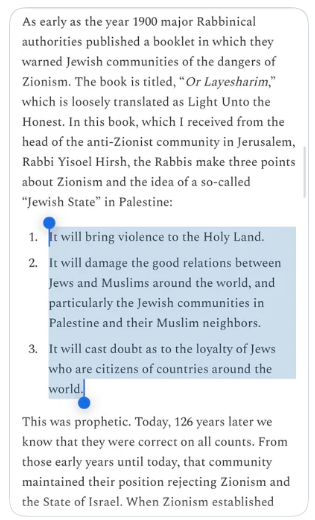
Interestingly, the pamphlet did not confine itself solely to theology. The contributors also made pragmatic predictions regarding the geopolitical reality of creating a state in Palestine. They warned that a political push for a sovereign state would destabilize the centuries-long co-existence between Jews and Arab populations in the region, ignite unprecedented localized tensions, and invite global accusations regarding the dual-loyalty of diaspora Jews to their home countries. [1]
Ultimately, Or la-Yesharim remains the ideological “Big Bang” for modern Haredi anti-Zionism, setting up a debate over faith, statehood, and identity that continues to reverberate today. [1, 2]